

How to reduce allergies while driving

Spring and early summer, with their longer days and warmer temperatures, bring an increase in airborne particles from trees, shrubs, and plants. This can cause discomfort for motorists with allergies, as pollen and other plant-based contaminants in the atmosphere reduce the effectiveness of cabin air filters that are often heavily saturated with dust, fine particles, bacteria, and allergens after months of winter driving – DENSO has responded.
Allergies can pose significant challenges while driving; for instance, hay fever can compromise driving safety. Sudden sneezing, watery eyes, and drowsiness can impair reaction times and vision. Effective cabin filtration, in light of longer pollen seasons according to DENSO, is critical.
In response, DENSO, an OE cabin air filter supplier to many VMs, says now is the ideal time to replace these components, a message that should be conveyed to workshop customers whenever a request is received for general service items. As a rule, whenever the oil and air filters are replaced as part of a scheduled service, so should be the cabin air filter, or at the very least, annually.
Dual opportunities
DENSO believes cabin air filters provide a couple of opportunities: first, they provide additional revenue, which helps cash flow, and second, they deliver genuine health benefits to drivers and their passengers.
The OEM emphasises that all cabin air filters are suitable for both occupants and the vehicle itself. These filters enhance the quality of cabin air and safeguard the internal components of the AC system, similar to many other products. Consequently, replacements are available in various types and qualities, offering different levels of filter efficiency and, consequently, varying degrees of personal and mechanical protection.
According to DENSO, a good-quality cabin air filter should provide a high level of protection from dust, soot, pollen, and particulates – likely to feature a multi-layer fleece material to capture dust and solid matter. The company claims this kind of filter is ideal for drivers who:
- Need a reliable and cost-effective OE-quality replacement
- Don’t usually drive in a high-traffic or pollution-heavy environment
- Want solid protection against everyday dust and pollen
Raising the bar
That said, DENSO believes its ClearAir+ stands out, designed to “raise the bar” when it comes to both filter efficiency and its environmental credentials. It delivers OE-grade quality for performance and reliability, trusted by many European car makers.
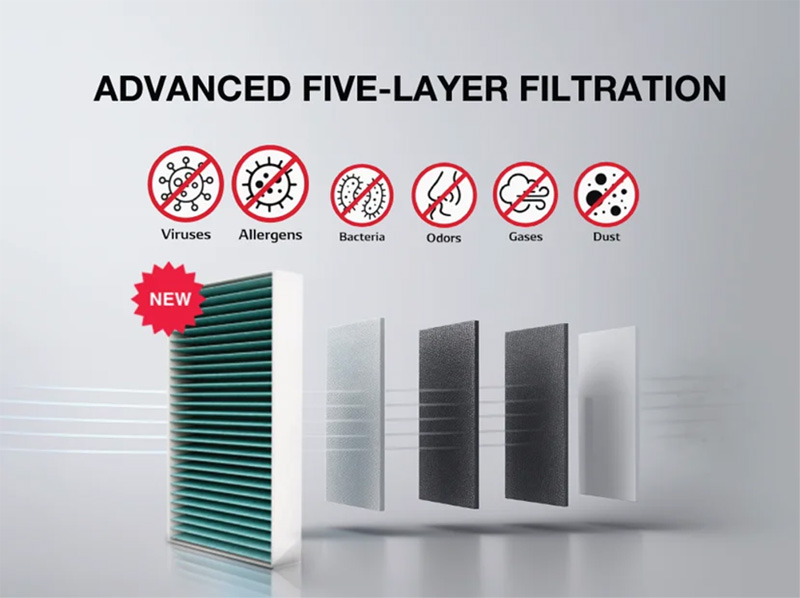
It features a unique five-layer filtration system that is engineered to not only block dust and gases but also odours, viruses, bacteria, and allergens. With the reassurance of ISO-certification and testing (ISO 20743, ISO 18184), DENSO claims ClearAir+ effectively captures 99 percent of bacterial and viral organisms and 96 percent of particles measuring 2.5 microns, as well as 80 percent of nitrogen oxide.
As a result, DENSO believes ClearAir+ is designed for drivers who:
- Frequently drive in urban or high-pollution environments
- Carry young children, elderly passengers, or people with allergies
- Want exceptional protection from odours, gases, and microscopic pollutants
- Want the highest possible standard of cabin air quality
Environmentally-friendly materials and processes
With the protection of the environment a key DENSO principle, its ClearAir+ range is designed to use environmentally friendly materials and production processes. This means that they offer reliability and sustainability alongside the efficient and effective removal of viruses and bacteria, airborne pollutants, and gases.
While cabin air filters generally consist of a first filter medium that keeps out coarse particles, supported by a filter fleece that increases its dust retention capacity, DENSO’s ClearAir+ filters use five active layers, including two of carbon. Then, by incorporating the latest developments in filtration technology, they are able to separate out vapours, odours, harmful gases, and remove fine dust, including micro particles with diameters smaller than 2.5 microns, while the anti-allergen layer is particularly beneficial during pollen season.
Finally, as well as improving air quality for those inside the vehicle, DENSO says its ClearAir+ filter will also protect the vehicle’s entire heating, ventilation and AC system. This is because the airborne particles that are naturally present in the atmosphere and drawn through the system to stick to the important elements within the unit are removed before they can do so. As a result, the system keeps running reliably and lasts longer.