

How does filtration quality effect emissions?
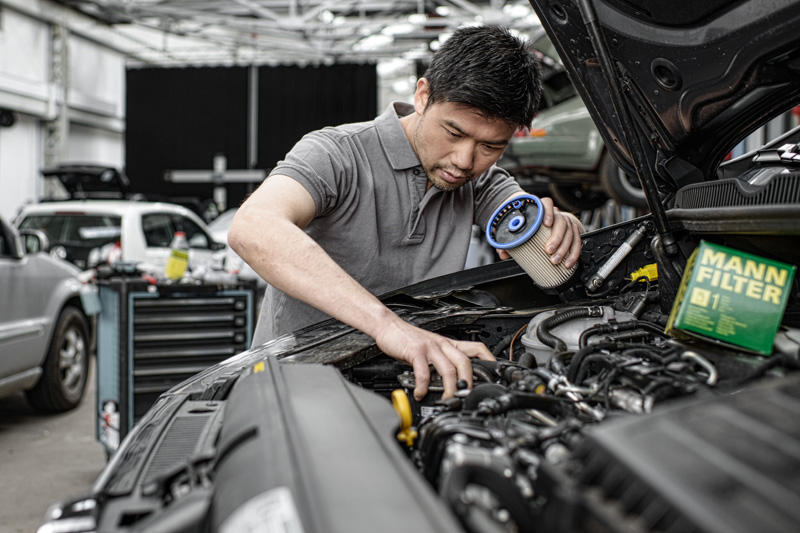
While filters are not necessarily emissions devices in the same way as catalysts, DPFs or SCR systems, according to MANN-FILTER, filtration quality has a measurable enabling effect on emissions stability. This is particularly true of engines, aftertreatment systems and onboard diagnostics, which are more sensitive to contamination, airflow deviation and fuel quality variation.
A modern engine’s air path is calibrated around a defined airflow and pressure drop. Consistent air filtration helps maintain the intended air-fuel ratio control, supporting stable combustion and reducing the risk of soot formation that can increase particulate loading downstream.
What’s more, high-quality air filtration helps reduce the ingress of abrasive dust that accelerates wear in turbochargers, piston rings and cylinder walls, says MANN-FILTER. These are “wear mechanisms” that can increase oil consumption and, in turn, particulate emissions and aftertreatment stress over time.
The key point is not “more power” claims, but “repeatable filtration efficiency and dust-holding capacity” that supports predictable service intervals and reduces the likelihood of comebacks linked to drivability or sensor-related fault codes.
Reducing oil-derived particulates and protecting after-treatment
Oil condition is a major contributor to real-world emissions performance, reports MANN-FILTER. Effective oil filtration helps control soot, wear metals and sludge, supporting stable lubrication and reducing the probability of elevated oil consumption. Lower oil consumption reduces the risk of oil ash accumulation in exhaust aftertreatment components, which can contribute to increased backpressure and reduced system efficiency over time.
If you’re supplying fleets, MANN-FILTER says this translates into lower risk of premature aftertreatment issues and more consistent emissions behaviour between services.
Supporting injector health and clean combustion
High-pressure injection systems are highly sensitive to water and fine particulates, notes MANN-FILTER. Fuel filtration that reliably separates contaminants helps protect injector spray patterns, which are critical for complete combustion. Poor atomisation can increase soot and unburned hydrocarbons, raising the burden on DPF regeneration strategies and potentially increasing fuel consumption – both of which influence carbon dioxide and tailpipe emissions outcomes in real operation.
Cabin air filtration: Indirect emissions and compliance value
Cabin air filters don’t change tailpipe emissions, but they matter because in-cabin air quality is increasingly part of fleet and corporate ESG expectations. Supplying premium cabin filtration supports your value proposition around “clean air” packages and scheduled maintenance bundles.
What does this mean in reality?
MANN-FILTER positions its emissions impact not simply in terms of compliance, but as a matter of risk reduction and long-term performance stability.
By helping to minimise airflow deviation, injector contamination and accelerated component wear, effective filtration can reduce the likelihood of emission-related comebacks. This means fewer repeat visits linked to drivability issues or warning lights triggered by underlying contamination problems.
Consistent filtration efficiency and strong dirt-holding capacity also contribute to improved service interval reliability. Maintaining stable performance between services is critical, particularly as modern engines and aftertreatment systems operate within increasingly tight tolerances.
In addition, protecting high-value components – including turbochargers, injectors and aftertreatment systems – plays a direct role in sustaining emissions performance over the life of the vehicle. Failure or degradation in any of these areas can have a measurable impact on output and compliance.
As UK emissions scrutiny shifts towards real-world durability, protection and consistency is not just desirable, but essential.