


The truth about antifreeze coolants

Confused about antifreeze coolants? They’re just winter products, right? Think again… Morris Lubricants’ Technology Manager, Adrian Hill, explores the “misunderstood” product to put you on the correct path.
Antifreeze coolants are often misunderstood; they come in many different colours, can often be overlooked as part of a regular service, and most importantly, not everyone is sure what they do!
These coloured functional fluids are very important, and it is vital to use the correct antifreeze coolant to help ensure that a car engine works at maximum operational efficiency. It is commonly known, given the product category name, that antifreeze coolants help protect the engine against freezing in the winter, but it is often a misconception that this is the sole benefit. There are a lot more features and benefits to these functional fluids.

Choosing and using the correct antifreeze coolants can be confusing. To help get a better understanding of what functions antifreeze coolants perform, plus the importance of choosing and using products with the correct specification, I have answered some frequently asked questions:
Antifreeze coolants are not just winter products
Antifreeze coolants are designed to protect engines and keep them working, regardless of the ambient temperature; therefore, they are products that are used all year round. Antifreeze coolants are not just used for the winter to protect against freezing; they also help keep the engine from overheating during the summer months, when the ambient temperature is hot or when a car is running yet standing still in heavy traffic for long periods of time.
Why not just use water to cool the engine?
Water is a fantastic cooling medium for a car engine, as it is effective at removing heat from around the engine’s combustion chamber – hence keeping the engine at an optimised running temperature. However, if the ambient temperature drops below 0oC, water will freeze and ice crystals will form. Ice is less dense than water and takes up more volume in the engine cooling system. With nowhere for this ice to go, it will force its way out, damaging the engine and the cooling system. Conversely, water boils at 100oC, and since the combustion process in a car engine can reach several thousand degrees, even in a pressurised system, the water can be lost as steam.
This is where antifreeze coolants and their balanced formulations take over from just water alone. To combat these physical challenges, monoethylene glycol (MEG) is used as the base for antifreeze coolants and for good reason. MEG disrupts the formation of ice crystals and will protect down to -40oC – by using a 50% mixture for example, with distilled, deionised or demineralised water – preventing damage. When the engine reaches operating temperature, MEG – within the pressurised cooling system – increases the boiling point and temperatures can reach 110oC.
What other functions do antifreeze coolants perform?
To protect the different metals and alloys used in the construction of the engine, the antifreeze coolant must also contain rust and corrosion inhibitors. Rusting and corrosion can happen due to the presence of oxygen or other contaminants, but the inhibitors either form a chemical barrier or neutralise the rusting and corrosive reactions. Rust and corrosion can also be prevented if the antifreeze coolant mixture has a slightly alkaline pH, usually around 8.5. This will also control the degradation of rubber and plastic components, such as hoses, seals and gaskets. Therefore, antifreeze coolants are enhanced with chemical additives, like pH buffers, to help to control this rusting, corrosion and degradation.
As the antifreeze coolant is pumped and churned around the cooling system, air can become entrained. The product also must have antifoaming properties. Foam is basically air bubbles, and air is not good at removing heat. This will not only lead to overheating, but also cavitation that will impede antifreeze coolant flow, making matters even worse. Antifoam chemical additives ‘break’ the foam and release the air.
Why are there so many antifreeze coolants available in the market?
Over the past 15 years, the development of engine technology has been very fast-paced, and many different engine designs have emerged. On the roads today, there are so many different engine types, such as petrol, diesel and hybrid, each with their own ways of developing power to the wheels. This complexity is a result of OEMs taking different approaches to help improve efficiency, reduce fuel consumption, improve reliability and lower emissions. To deliver on these new engine platforms, the OEMs are using innovative materials and alloys in the manufacturing of these new engine designs.
The antifreeze coolants, therefore, must be manufactured to perform in engines made from these differing materials and not corrode the engine, its components or parts of the cooling system, such as the water pump, hoses and radiator.
What does this mean?
This means that there is not one antifreeze coolant that will suit all types of engine design. Antifreeze coolant formulations are developed and tailored to meet the strict demands of the OEMs, of whom there are many.
The market consists of traditional two-year antifreeze coolants, with ‘old school’ fast-acting chemistry and five-year coolants that manage protection in a more controlled way. But as the metallurgies used in engine designs continue to develop, alongside changing duty cycles, antifreeze coolant technology has needed to evolve in parallel, to help maximise engine protection as well as to prevent freezing and overheating.
This delicate balance of chemistry is essential to protect engine platforms and ensure maximised operating efficiencies. The OEMs drive the development of these formulations, targeting which chemical additives are needed – hence buying and using the correct antifreeze coolant is essential!
My top tips
- Don’t select based on colour: Colour is purely cosmetic and does not contribute to performance.
- Never mix antifreeze coolants with different specifications: They may react and cause system issues.
- Never mix with tap water: Hard water salts can block the cooling system. Always use distilled, deionised or demineralised water.
- Follow the service guidelines set by the OEM and change accordingly: Two years or five years, depending on the antifreeze coolant specifications.
- If the vehicle is new to you without any service history, change the coolant as an insurance policy.
- Routinely check the cooling system, looking for leaks, split or cracked hoses. This will ensure maximum system efficiency.
- If you are unsure of the OEM specification required, seek technical advice. The correct specification will ensure maximum protection.
- Check and maintain the coolant level all year round. The coolant is essential for both hot weather as well as cold.
- Use the correct mix ratio with distilled, deionised or demineralised water (50:50, for example) to ensure high and low temperature protection is achieved.
- Correct coolant selection contributes to optimised engine operation and efficiency.
This is only a very short overview of this vitally important functional fluid. If you want to find out more about the importance of selecting and using the correct antifreeze coolant, head over to the Morris Lubricants YouTube channel now: www.rdr.link/
Here you will find a series of short and longer videos where I dive deeper into the topic of antifreeze coolants.
The Morris Lubricants Ultralife range
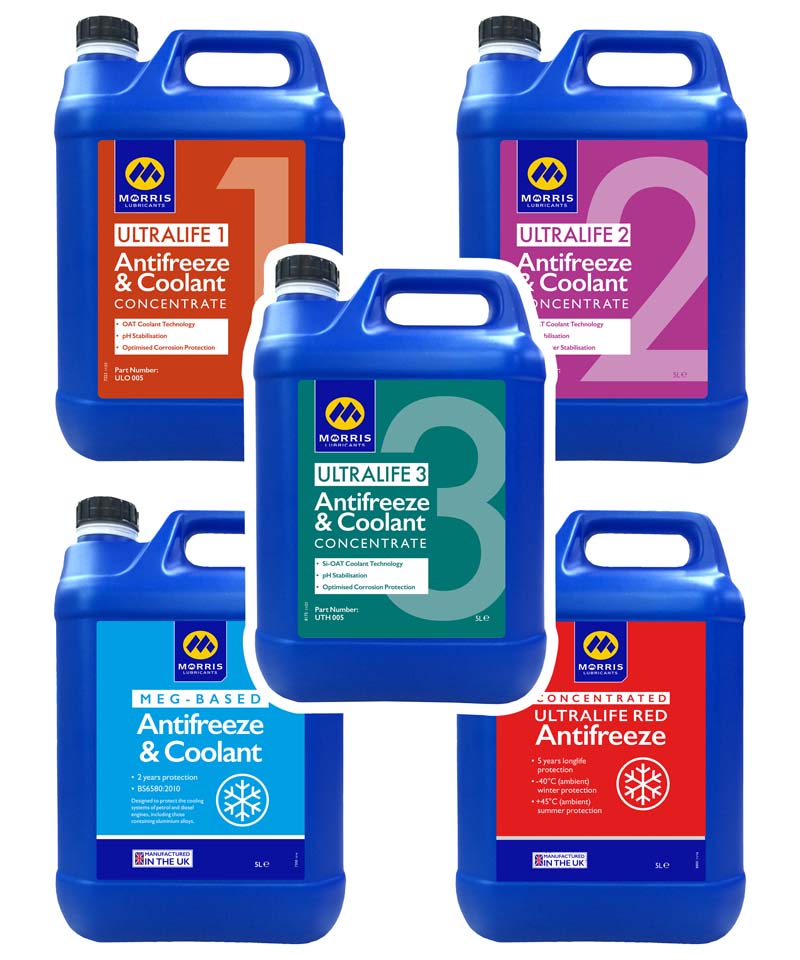
At Morris Lubricants, we have developed the Ultralife range of antifreeze coolants to cover a broad range of car engines and across many different manufacturers. The Ultralife range is ideal for fleet managers, dealerships and technicians that are maintaining a variety of different vehicle technologies, OEM brands and vehicle models.
Confused? Is there too much choice? Are you not sure what to use? Don’t worry, you can seek help from our Whatoil online oil, lubricant and functional fluid finder. Searches on this online tool are easy, and, often, by just entering a car registration number, you can see what antifreeze coolants are recommended.