

IAAF looks to forge a ‘New Aftermarket’
The Independent Automotive Aftermarket Federation (IAAF) annual conference, once again taking place at the DoubleTree by Hilton Milton Keynes on 4 December, signalled the end of another busy 12 months in the trade. This year, IAAF looked to the future – focusing on how the sector can adapt to cultural, economic and behavioural shifts.
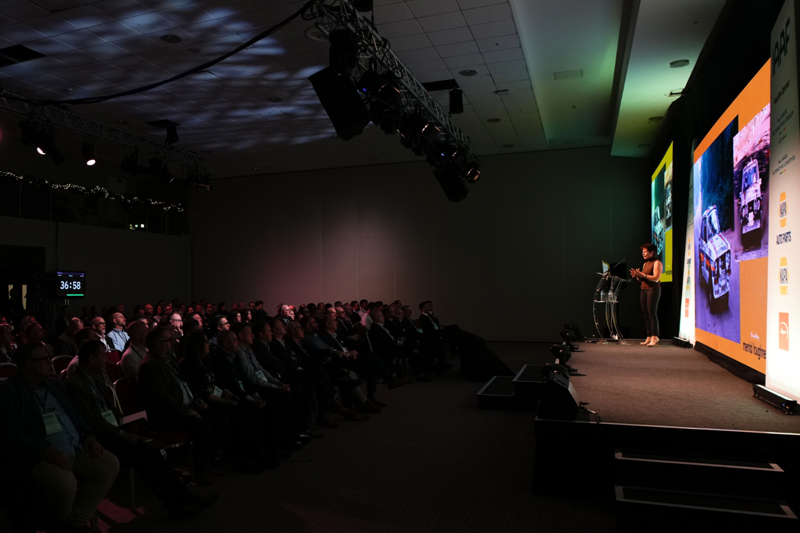
Former rally driver and television presenter, Penny Mallory, began proceedings with a speech about the importance of mental toughness. She took the audience on a trip down memory lane, explaining how mental resilience shaped her career, challenges and successes.
Penny was the first woman to compete in a World Rally Car for Ford in the World Rally Championship after becoming a national rally champion. She became “obsessed” with human performance, specifically mental toughness.
Addressing the audience, Penny spoke about how she overcame the stigma that came from being a “woman in a man’s world”.
She said: “I was in my world, so I didn’t feel like I could give a sensible answer (to a journalist’s question about competing against men). I just wanted to compete – it wasn’t about gender – and my attitude, my approach was most important.”
Penny claimed that 70% of achievement is down to mental toughness – the other 30% is skill, talent or intelligence: “It what makes the difference to success.” Bringing it back to the challenges the automotive aftermarket may face, Penny was adamant that it is “the hard stuff that creates us” and “our mental responses to situations that are fundamentally important to life”.
Penny split mental toughness into four sections: control, confidence, challenge and commitment, and revealed personal battles that drove her from despair to realising a dream.
Struggling to cope with her mother’s alcoholism and manic depression, Penny’s behaviour and schoolwork deteriorated; nudging into adolescence, bad behaviour turned into crime and drinking. At 14 she received a letter from her estranged father that worsened things; she lived in hostels in London and her boyfriend was a heroin addict — she hit “rock bottom”.
She continued: “I had to decide – good or bad – and I decided to follow my dream and put myself into rally school. It changed my life entirely. I went from roughest to toughest. I was intensely driven to become a champion. Nothing was going to stand in my way… Adversity proved useful; it built my focus, resilience and confidence.”
Impact of the JLR cyber-attack
Inevitably, the impact – and recovery – of the Jaguar Land Rover (JLR) cyber-attack was brought to the attention of conference in the next discussion. David Bailey, professor of business economics at Birmingham Business School, delivered the headlines: JLR reported pre-tax losses of about £485 million in the three months to 30 September 2025 after production was shut for much of September. That represented a sharp reversal from a profit in the same period a year earlier.
David also highlighted the wider economic ripple effects, citing independent assessments that put the broader UK economic hit into the region of £1.9 billion, reflecting supplier disruption and knock-on supply-chain losses. Estimates for weekly losses during the shutdown vary, but the centrepiece figure for company pre-tax losses is the quarterly number above.
US, China and EU squeezing UK growth
David lamented the impact of international trade frictions and rising costs on the UK sector. He pointed to a UK-US trade arrangement in 2025 that reduced certain US tariffs on UK cars from 27.5% to 10% – but only on the first 100,000 UK-made cars exported to the US.
David also emphasised that Brexit-related frictions and energy costs that are constraining competitiveness: the UK continues to face higher industrial energy prices than some European peers, and inflationary pressures remain a drag on growth. While the government is looking at introducing the British Industrial Competitiveness Scheme from 2027 to ease energy pressure for over 7,000 electricity-intensive businesses, not households, David said this “wasn’t ambitious enough”.
Meanwhile, David claimed China remains a dominant force in EV manufacturing and battery supply, arguing that the UK must attract large-scale investment in vehicle and battery production to strengthen domestic industry.
On SMMT forecasts, the Society of Motor Manufacturers and Traders expects the UK new-car market to grow to about 2.012 million units in 2025. If realised, that would break the two million mark for the first time since 2019 – and BEV registrations are forecast to continue rising as a share of the market. The SMMT expects BEV share to increase materially.
David emphasised that BEV uptake is still constrained by upfront costs and “patchy” charging infrastructures. He noted battery prices are trending down: industry trackers, such as BloombergNEF and other analysts, report steady falls in lithium-ion battery pack costs, and the widely cited industry “tipping point” is around $100 per kWh, at which point many analysts expect cost parity with petrol-powered vehicles to be achievable.
Concluding his presentation, David said China is “way out in front”. Where it was once mainly a producer of lower-cost models it now leads in battery production and EV scale – and he argued the onus is on the UK to improve investment, scale and local industry to avoid falling behind.
Emerging aftermarket models and fleet work
Before lunch, Max Wegner of Roland Berger deep-dived into emerging aftermarket business models, sharing data that show consolidation trends and changing routes to market, while Tim Guidotti of Ferdotti Motor Services highlighted the growing importance of fleet work across cars, vans and commercial vehicles.
Branding Gen Z
Emerging from the break, Mickey Wilson from Firestarter tackled Gen Z — how businesses should attract them as both consumers and professionals. With five different generations in the workforce, understanding how to communicate across diverse expectations has never been more crucial.
Mickey argued that flexible subscription models are likely to increase (possibly stretching into car ownership), communication will get faster, and AI will become ever more influential – so staying ahead technologically while maintaining strong customer engagement is essential.
During Mickey’s presentation, she shared a piece of research to help answer the question: When it comes to cars, what do Gen Z really want?
Deloitte’s Global Automotive Consumer Study shows that younger people (18-34) are more open to car-subscription models – about 28% of 18-34-year-olds show interest – and Autotrader research indicates that many younger drivers prioritise in-car tech over looks (Autotrader reports roughly 63% of 17-25-year-olds rank a car’s technology above appearance). These forces together suggest a shift in product and marketing priorities for businesses.
Entering The Garage Den…
To end this year’s proceedings, IAAF introduced a new concept – designed to bring suppliers and independent workshops closer together – dubbed The Garage Den. Five workshop owners acted as ‘dragons’ with representatives from Milwaukee, TechMan, HELLA, WAI and Cataclean delivering product pitches. Tough – arguably brutal – questions followed, but pitchers stayed cool under pressure. Whether the concept was a success is for the brands involved to judge – but dragons appeared to enjoy putting the suppliers under the spotlight!
As the delegates filed out, there was plenty to ponder before dinner and awards – ideas that could be applied to day-to-day business in the weeks and months ahead. Ultimately, the IAAF conference is designed to inform, challenge and inspire, so those that attend are better prepared for whatever the future holds.