


Carwood aims to break VM monopoly
From battery distributor in 1966 to repairer today, much has changed during that time. Carwood is going back to its roots and is confident its latest launch – high voltage battery repair – is another example of how the company is staying ahead of the curve. Its aim is to provide the trade with cost-effective, sustainable solutions for the latest generation vehicles. Head of Engineering – Automotive Solutions, Lee Jacobs, reveals how it plans to achieve this.
Car batteries are where Carwood started. Back then they were based on a century-old design; flooded lead-acid batteries with a standard 12V system that powered the starter motor, ignition system, the lights and a lesser number of other more rudimentary electrical systems. We distributed batteries for a wide range of applications: from the infamous Reliant Robin to earth movers – and pretty much anything in between!
Fast forward to today, and there are many similarities with the batteries of 60 years ago. The latest EVs still use a 12V battery to power an ever-growing range of vehicle systems. And on paper, they’re still the same lead-acid design, although manufacturers are gradually switching to lightweight, higher energy density lithium-ion 12V batteries.
Whilst BEVs are not new – they were first used in the early 19th century – the big change is the addition of a high-voltage battery system providing the primary energy for propulsion. Also known as a drive or traction battery, it powers high torque electric motors at the wheels, which move the vehicle.
Most hybrids and EVs use a 400V architecture, with some now at 800V. Unlike conventional ICE vehicles with a 12V alternator, these batteries are recharged via a cable or regenerative braking, requiring completely different servicing solutions compared with the batteries we originally worked with.
Fortunately, here at Carwood, alongside Bosch, we’ve come up with a solution.
An electric opportunity
As hybrid and EV adoption continues to grow, so too will the demand for affordable, high-voltage battery servicing. Until now, that demand has largely been met by the VM network due to the complexity and safety challenges, a lack of qualified independent workshops, and few viable service options – either replacing only individual faulty modules, which risks compromising the battery’s performance and lifespan, or replacing the complete battery pack, which is both inefficient and expensive.
New batteries for older 400V hybrid technology can cost upwards of £2,000, rising to £20,000 for the latest large capacity 400V/800V battery packs.
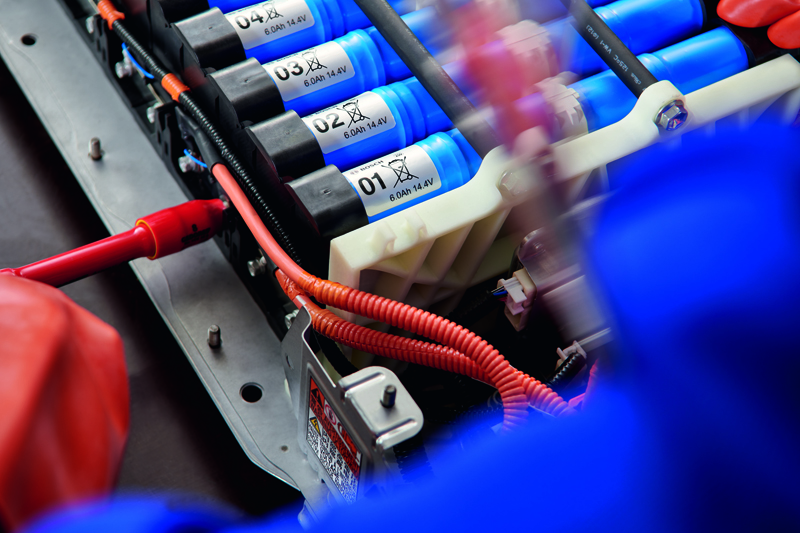
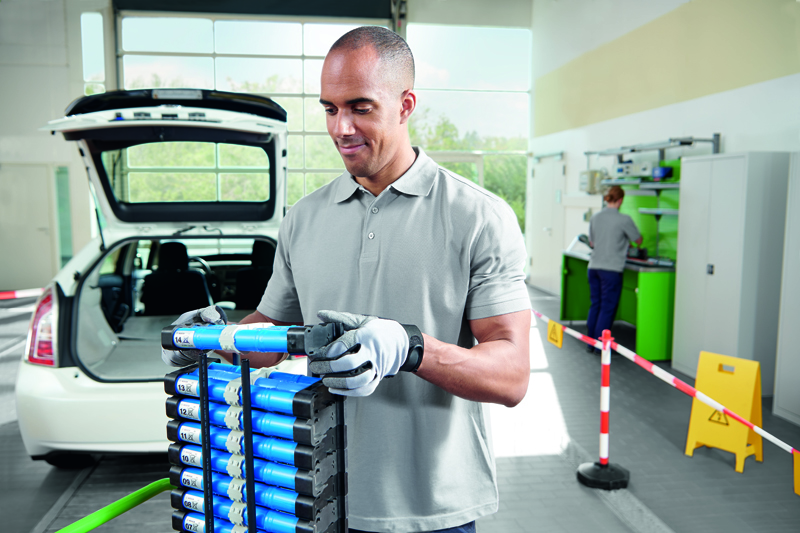
Now, Bosch’s high-voltage solution for Toyota Yaris, Prius, Auris and Lexus CT enables the replacement of the batteries’ modules, whilst reusing other components. Each Bosch module is voltage and capacity matched, just like in a new battery pack, ensuring the same like-new capacity, voltage and charging. By swapping out all the old modules with brand new nickel metal hydride modules, we can return the battery to its original state.
The all-or-nothing approach ensures a balanced module set, eliminating any voltage, internal resistance and state of charge imbalance – plus the potential for costly repeat failures that come with mismatching old and new modules.
It also avoids the need for full replacement. By reusing all other good, functional components – such as the housing, fan and electronics – we can help to close the loop on material flow and save parts that would have been otherwise destined for landfill or recycling. As well as saving valuable material and resources, it saves money too. A repaired high-voltage battery from Carwood costs on average 25% less than a new unit.
Breaking the VM monopoly
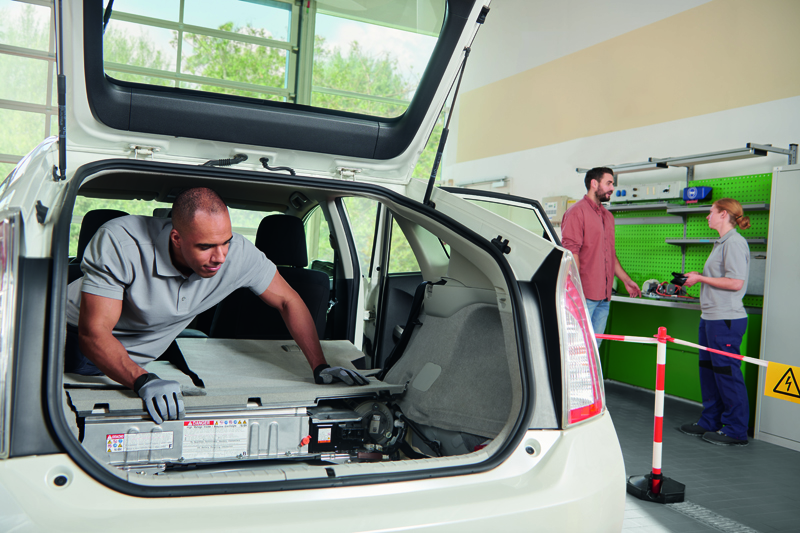
The high-voltage repair solution will help break the VM stranglehold by offering independent workshops, fleet, vehicle owners, and, ultimately, the factor network, a proven-quality, cost-effective alternative.
By partnering with an EV battery repairer, independent workshops without the necessary training and skills can position themselves as an EV-capable workshop without having to handle the repair in-house.
And although not commercially available yet, its exchange programme with core return will enable you to tap into the growing opportunity and add yet another product and service capability to your list.
So, although we’re going full circle at Carwood – back to our battery roots – the launch of high-voltage battery repair is very much forward-focused. It will ensure we, along with the independent aftermarket, can transition into the EV battery service space.