


According to TotalEnergies, you play an essential role in the lubricant selection process and in supporting workshop customers through the adoption of new and beneficial technologies.
You may have heard of re-refined base oils (RRBOs) but previously written them off under the historic preconception that they are inferior to virgin oil products. Thanks to recent innovations in the lubricant industry, though, times have changed. TotalEnergies Marketing UK Aftermarket Sales Manger, David Valentyne, explains why.
RRBOs are now a credible alternative to virgin oil products – and, in some cases, we believe they are a better option. Modern RRBOs are delivering sustainability benefits to the aftermarket and end-users, without compromising on lubricant quality and, ultimately, engine performance.
What are re-refined base oils?
RRBOs are base oils produced from used engine, hydraulic or industrial oils. These materials would otherwise be classified as hazardous waste and safely disposed of.
Now, through a sophisticated ‘rerefining’ process, these used oils can be treated to restore properties comparable to the best virgin base oils. This process removes contaminants, dirt, water and particulates, followed by advanced treatments that yield high-quality base oils suitable for producing lubricants for the most modern of engines.
Engine oils usually fall into one of three categories – Group I, used in older engines, and Group II and III, which serve more modern vehicles. Historically, ‘recycled’ oils – or RRBOs – were generally seen as poorer quality Group I lubricants.
However, advances in re-refining technology now enable RRBOs to span Group II and Group III categories, making them suitable for most contemporary vehicles. Today, premium RRBO products can match virgin oils in quality and performance and surpass them in sustainability credentials. The improvements in RRBO technology mean the industry is closer to a fully 360-degree circular model – with used oils going back into the supply chain and reducing reliance on virgin oil extraction.
Why demand for re-refined base oils is rising
Several factors have converged to make RRBOs a compelling stock choice:
- Regulatory momentum: Waste oil management has long been regulated in the UK and Europe, and an important compliance issue for workshops to consider. While incineration was once common, recent legislation – such as the Waste Framework Directive – has shifted the focus to recycling and circularity. According to a 2023 report from the commission to the European Parliament and Council, around 82% of theoretically collectable waste oil across Europe is successfully collected, and 61% of that is regenerated. Regenerated base oils now represent approximately 8% of annual base oil production in the EU. This figure is likely to grow as sustainability targets tighten.
- Environmental impact: Facilities, such as Tecoil in Finland and now part of TotalEnergies, use green hydrogen produced on site to power the regeneration process, further reducing the carbon footprint of RRBOs. Meanwhile, the Tecoil rerefining process achieves a twelvefold saving on CO₂ emissions compared to virgin oil refining. The process can be repeated indefinitely, creating the potential for a ‘closed loop’ system for engine lubricants.
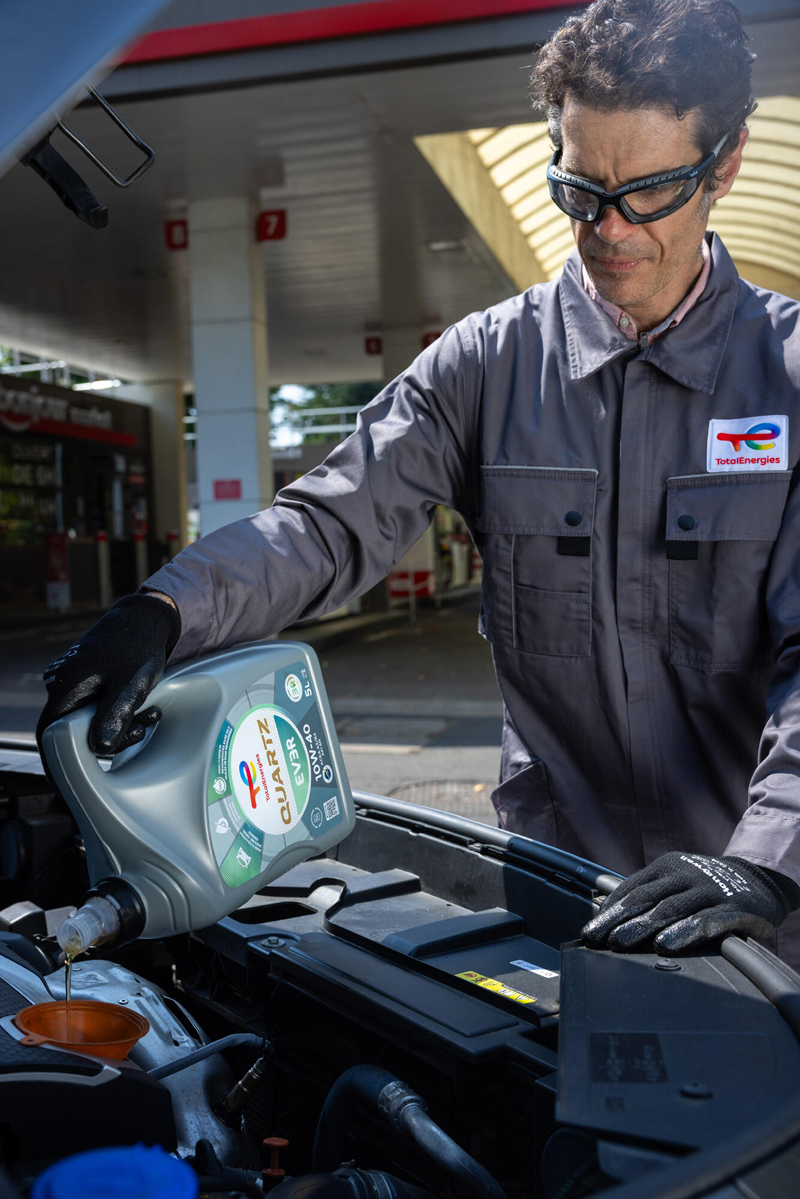
- Performance and compatibility: Our EV3R range of RRBOs has been produced to meet the API Group II/II+/III technical standards and is compatible with a wide range of OEM specifications, including Peugeot, Citro.n, DS, Opel, Vauxhall, Renault, Volkswagen and Mercedes-Benz. Quartz EV3R 10W-40 demonstrates how RRBO technology can deliver performance while meeting OEM requirements and supporting sustainability goals.
- Market demand: There is growing demand from both industry and vehicle owners for products that combine high performance with strong sustainability credentials.
With around 40 million cars in the UK and an estimated 150–250 million litres of lubricant circulating on the roads, the opportunity to regenerate used oil into new lubricants is significant. The GEIR (European Waste Oil Re-refining Industry Association) has been lobbying to introduce specific waste oil collection and regeneration targets in Europe and, if adopted, this may drive up demand further still.
Circular economy advantage
We acquired Tecoil in 2024 to accelerate the development of RRBOs and to increase market capacity for these cutting-edge products.
Tecoil’s 50,000-tonne-per-year facility collects used lubricants across Europe and regenerates them into high-end base oils for premium lubricants. Combined with our lubricant engineering innovation and research and development, this led to the development of the EV3R range.
In addition to being supplied in fully recyclable packaging, Quartz EV3R is Europe’s first engine lubricant made from 100% premium regenerated base oils.
With workshops already having to comply with stringent waste management rules and reduce their carbon footprint, there is increased attractiveness for products which contribute to ‘circularity’ – i.e. a model where the life cycle of products is extended, in some cases indefinitely, and where new value can be extracted from a product once used.
For you, modern, premium quality RRBOs are an exciting addition to the lubricant market – delivering customers performance, peace of mind and enabling more sustainable, circular maintenance and motoring.